
Old Wing Mission
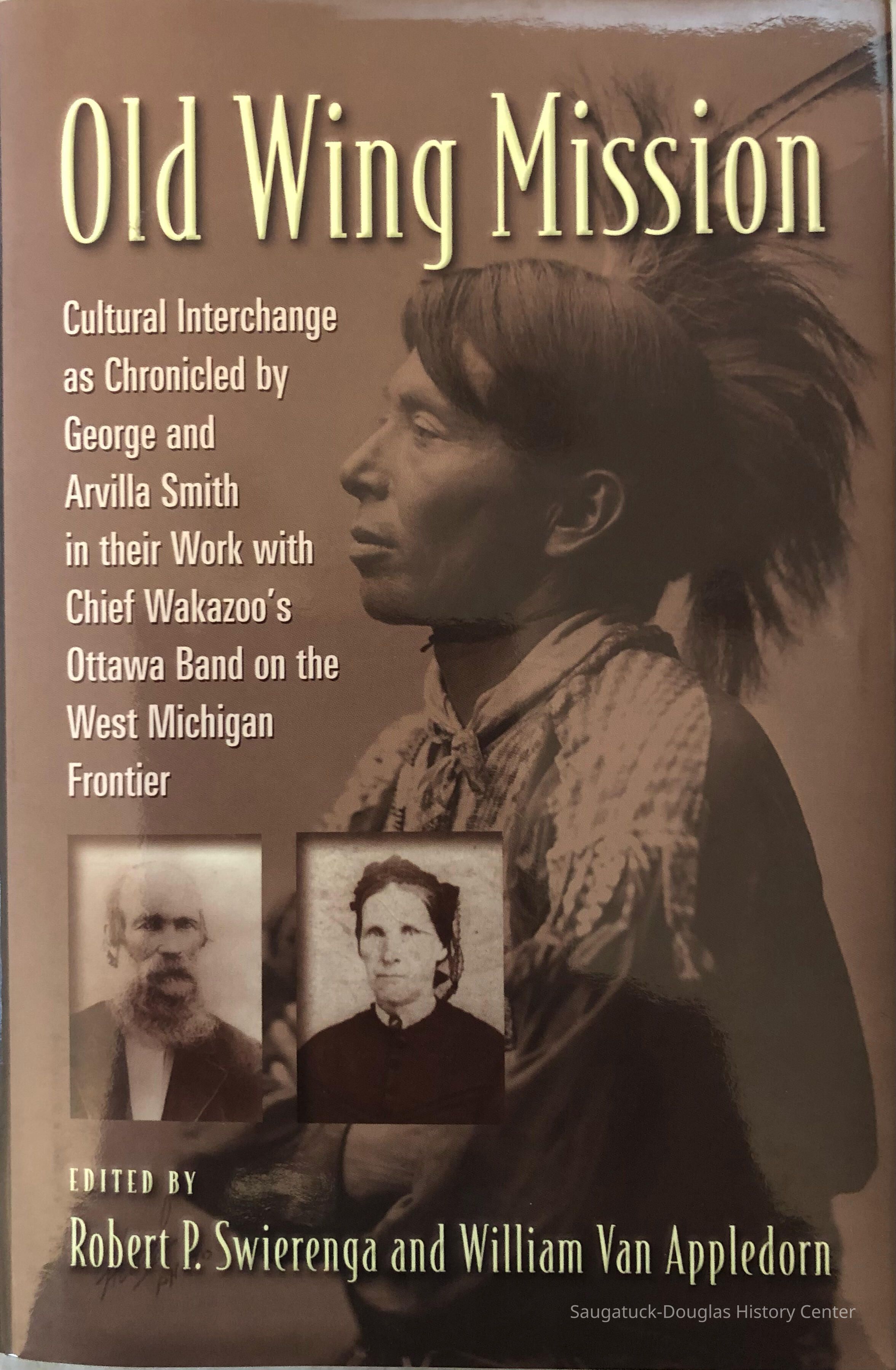
2019.35.233
0001 Anishinabek/Ojibwe/Odawa/Bodéwadmi1830 Settlement, pioneer era
Slusar, Vern
2019.35
The Historical Series of the Reformed Church in America in Cooperation with the Van Raalte Institute No. 58
Lorenz , Charles J.Native AmericansOld Wing Mission
Swierenga, Robert P.Wm. Van Appledorn
William B. Eerdmans Publishing Company
Grand Rapids, Michigan
Ottawa Indians - Missions - Michigan Ottawa Indians - Michigan - Religion Old Wing Mission (Mich) - History Protestant Churches - Michigan - Missions - History Smith, George Nelson, 1807 - 1881 - Diaries Smith, Arvilla Powers. 1808 - 1895 - Diaries Missionaries - Michigan - Diaries
970.00497 SWI
978080286381
xx, 684 p. : ill., maps ; 23 cm.
Library
Smith, Arvilla Almira (Powers) 1808-1895Smith, George Nelson Sr. 1807-1881Waukazoo, Chief Joseph
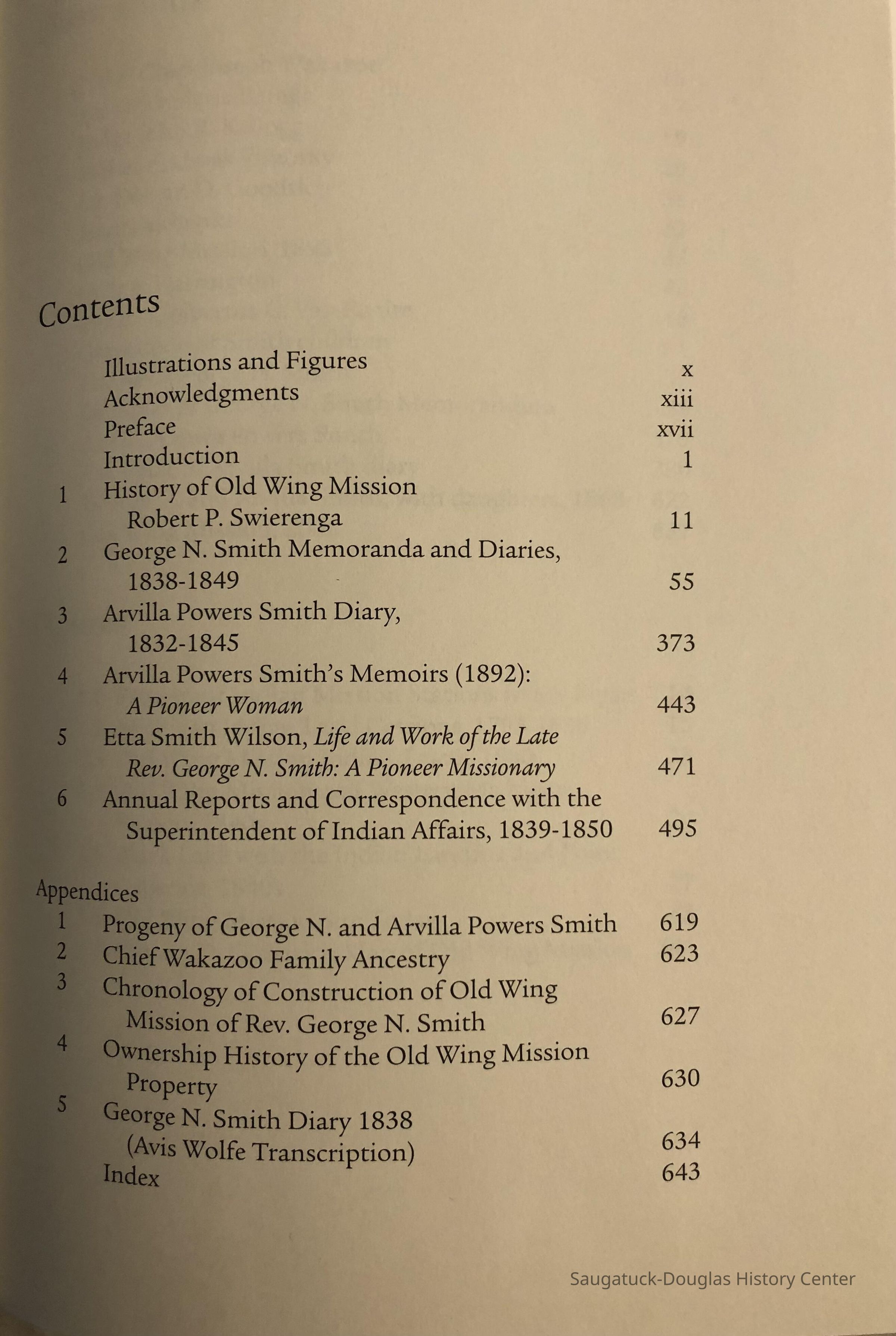
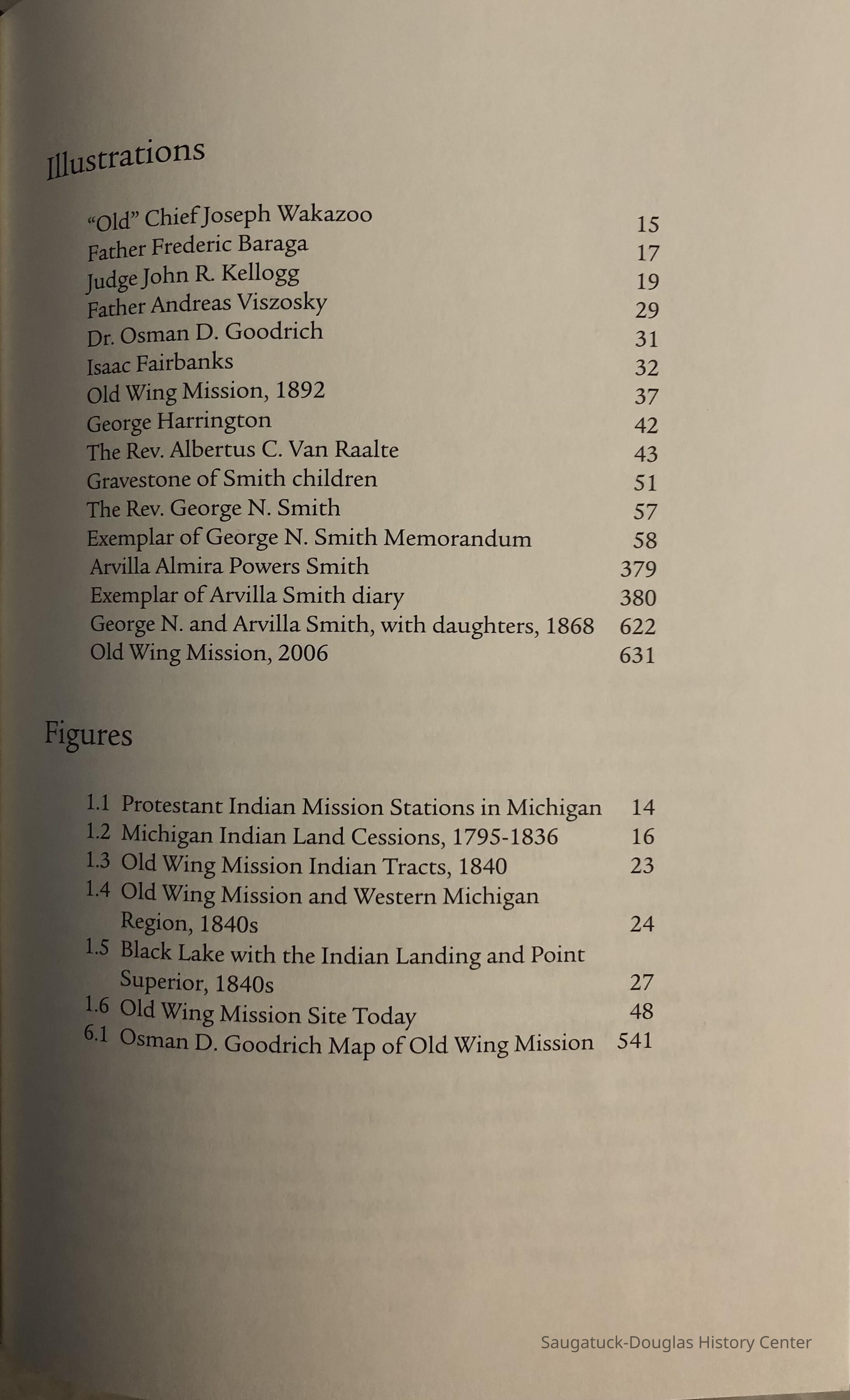
Home Publications Robert P. Swierenga -- Publications  Old Wing Mission: The Chronicles of the Reverend George N. and Arvilla Powers Smith, Missionary Teachers of Chief Wakazoo's Ottawa Indian Band in Western Michigan, 1838-1849 Robert P. Swierenga and William Van Appledorn Editors A.C. Van Raalte Institute Hope College Holland, Michigan 2007 For Charles J. Lorenz Whose labor of love made this book possible In Appreciation Avis D. Wolfe For her knowledge of the George N. Smith family history, and her diligence in preserving it for posterity Contents Preface Illustrations Figures Acknowledgments Introduction Chapter 1 History of Old Wing Mission Robert P. Swierenga Chapter 2 George N. Smith Memoranda and Diaries, 1839-1849 Chapter 3 Arvilla Powers Smith Diary, 1832-1845 Chapter 4 Arvilla Powers Smith, A Pioneer Woman Chapter 5 Etta Smith Wilson, Life and Work of the Late Rev. George N. Smith: A Pioneer Missionary Chapter 6 Annual Reports and Correspondence with the Superintendent of Indian Affairs, 1839-1850 Appendices 1. Progeny of George N. and Arvilla Powers Smith 2. Chief Wakazoo Family Ancestry 3. Chronology of Construction of Old Wing Mission of Rev. George N. Smith 4. Ownership History of the Old Wing Mission Property Index Preface Old Wing Mission on the Allegan-Ottawa County border was preeminent among the Indian mission stations on the Michigan frontier, all of which were staffed by Presbyterian and Congregational missionaries under the jurisdiction of the superintendent of Indian affairs at the Mackinac Agency in Detroit. Old Wing was the only station to have a missionary teacher in the employ of the government. In all the other stations, churches or private societies had to support missionary teachers. Old Wing also had a government-appointed agricultural teacher, as did several of other stations. The Protestant mission stations in Michigan, besides Old Wing, included the Mackinaw Mission to the Chippewas on Mackinac Island (1822-1837) run by the Reverend William M. Ferry and his wife Amanda White Ferry; the Thomas Station of the Reverend Isaac McCoy to the Ottawas and Chippewas at the Thornapple River near Grand Rapids, which closed in 1836; the Ottawa Baptist Mission of Elder Leonard Slater at Gun Plains in Barry County, established in 1838 to replace the Thomas Station; the Reverend James Selkrig's Griswold Episcopal Mission to the Ottawas at Bradley in Allegan County established in 1839; the Methodist Mission of the Reverend A.C. Fitch to the Pottawatomies near Marshall in Calhoun County; the Reverend Peter Dougherty's Presbyterian Station to the Ottawas at Old Mission in Grand Traverse County; Abel Bingham's Baptist Mission to the Chippewas at Sault Ste. Marie, the Reverend Wm A. Brockway's Methodist Mission at Little Rapids and at Kewawenon (near Sault Ste. Marie), and the Reverend George Bradley's Methodist Mission to the Swan Creek and Black River band of Chippewas at Flint. Stephen Fairbanks was appointed in 1843 as agricultural agent for both the Ottawa and Griswold missions. All these Indian ministries were spurred by the evangelical fervor awakened by the Second Great Awakening of the 1820s. Government policy under president Andrew Jackson and his successors, Martin Van Buren and James Polk, was to force American Indians to move west across the Mississippi River into "Indian Territory" or become settled farmers like white settlers on the frontier. Chief Joseph Wakazoo (the chief signed his name without the "u" the corrupted spelling, "Waukazoo," came into general usage among Americans in the early twentieth century) and his Black River Band of Ottawas, one of the three tribes that dominated in Michigan, along with the Chippewa and Potawatomie, chose the latter course, as did all the mission Indians. With the help of the Presbyterian Church of Michigan, Wakazoo's band hired the Reverend George N. Smith (1807-1881) to lead them. Smith and his wife, Arvilla Almira Powers (1808-1895), both kept daily diaries, George for nearly fifty years and Arvilla for eleven years. These rare, historic documents, numbering in the thousands of pages, provide a clear picture of life on the Michigan Indian frontier. They also reveal the intense religious struggles between Catholic priests and Protestant preachers for the souls of the Indians and the cultural conflicts that marked Indian-white relations. Smith and the mission Indians shared a deep bond of affection and even deep love for one another, but troubles surfaced repeatedly because of differing expectations regarding schooling for the children, Sabbath observance, alcohol use (and abuse), farming practices, and other issues of life-style and values. Smith family descendents preserved most of the writings of their progenitors, which are held today in the National Archives and the Bentley Historical Library of the University of Michigan. In the 1980s, historian Charles J. Lorenz of Saugatuck, Michigan, uncovered these documents and laboriously transcribed the writings pertaining to the 1840s, which provide a detailed history of the Old Wing Mission. In 1849 Wakazoo's band relocated permanently to the Leelanau-Grand Traverse Bay region (now Northport), and the mission continued under a new name for another forty years. This book includes the entire diary and reminiscences of Arvilla Powers Smith, but only that portion of George Smith's voluminous memoranda and diaries pertaining to the Old Wing Mission (1839-1849) located in the Black Lake watershed of Lake Michigan. When the mission was relocated to the north country in 1849, the geographical setting and community social networks changed drastically. The Northport mission deserves its own account, but our interest is primarily in the early history of what is now Holland. More importantly for our purposes, Smith's daily annotations degenerated into little more than reporting on the weather and the title and scripture text of his Sunday morning sermons. Climatologists and weather historians may find the daily record of high and low temperatures, rainfall amounts, and cloud conditions to be of interest, but the record is less gripping for social historians. Sickness and death were common on the frontier, and both diarists recount in agonizing detail the misery of unhealthy living conditions and the primitive state of medical care. But students of midwifery, diseases, folk remedies, and medicines such as opium and quinine will be fascinated by the first-person accounts of the primitive practice of medicine on the Indian frontier. Another aspect of the story of Old Wing Mission that will intrigue scholars of Indian-white relations is the decision of the Reverend Albertus C. Van Raalte in 1847 to plant his Holland Colony in the midst of the Ottawa Indian Mission Colony. Within two years, several thousand Dutch settlers fresh from the Netherlands were cutting down trees and opening farms in and around the Indian settlement. The white "invasion" was generally peaceful, although sharply differing cultural values caused friction, and in 1849, Chief Peter Wakazoo, Chief Joseph's brother and successor, in order to preserve the Indian way of life and culture, led the band to relocate to Northport. There they continued their hunting and gathering ways. But in less than a decade whites pushed into this region as well, and the Indians had to learn to live on their own farms among the whites. Some descendents of Wakazoo's band still reside in the Grand Traverse region. Illustrations "Old" Chief Joseph Wakazoo Father Frederic Baraga Judge John R. Kellogg Father Andreas Viszosky Dr. Osman D. Goodrich Isaac Fairbanks Old Wing Mission, 1892 George Harrington The Rev. Albertus C. Van Raalte Gravestone of Smith children The Rev. George N. Smith Exemplar of George N. Smith Memorandum Arvilla Almira Powers Smith Exemplar of Arvilla Smith diary George N. and Arvilla Smith, with daughters, 1868 Old Wing Mission, 2006 Figures 1.1 Protestant Indian Mission Stations in Michigan 1.2 Michigan Indian Land Cessions, 1795-1836 1.3 Old Wing Mission Indian Tracts, 1840 1.4 Old Wing Mission and Western Michigan Region, 1840s 1.5 Black Lake with the Indian Landing and Point Superior, 1840s 1.6 Old Wing Mission Site Today 6.1 Osman D. Goodrich Map of Old Wing Mission Acknowledgments Many people assisted in the publication of this documentary history, but none more than the late Charles J. Lorenz of Saugatuck, Michigan. In 1984 Lorenz and his wife, Christine, purchased the historic home of the Reverend George N. and Arvilla Powers Smith, which was constructed in 1844-45 and served as the heart and center of the Old Wing Mission, and converted it into a bed and breakfast. The building, Holland's oldest historic landmark home, has a rich history that is important to Native Americans, Dutch Americans, and all those interested in Christian missions to the Indians. The Lorenzes carried forward the restoration of the home and brought it up to code with new electrical wiring, plumbing fixtures, and exterior materials. More important for this publication, Charles Lorenz took upon himself the Herculean task of locating and transcribing the original memoranda and diaries of George N. and Arvilla A. Powers Smith. He learned to decipher the very challenging handwriting of both George and Arvilla, which task was further complicated by oft-faded ink or ink that bled through the paper onto the other side. Lorenz's quest for source documents took him to research libraries in Grand Rapids, Ann Arbor, Leland, and Washington, D.C., and he also searched the U.S. Senate Executive Documents, known as the "Serial Set," to find reports and correspondence pertaining to Old Wing Mission in the Bureau of Indian Affairs. Finally, Lorenz began the task of editing the diaries, compiling lists of Indian families living under the protection of the Old Wing Mission, and writing the first history of the Mission and the labors of George and Arvilla Smith on the Michigan frontier. Lorenz donated copies of all his materials and writings to the Holland Museum Archives before his death in 1994. We are very grateful to Christine Lorenz for granting us permission to use the material that Charles collected and transcribed. As editors, of course, we were obligated to reread every word of the original diaries and other documents. But to do so in front of a computer screen containing the Lorenz transcription made our task so much easier. All we had to do was determine if our reading of each word and sentence in the original copies agreed with that of Lorenz or not, and if not, whether he or we had the better sense of the text. We take responsibility, of course, for the edition published here and believe it is the most accurate rendition humanly possible. We also profited greatly from the knowledge of Avis D. Wolfe of Northport, the wife of Clarence B. Wolfe, a descendent of both the Wakazoo and Smith families. Clarence and Avis Wolfe remain active members in the church that Smith commenced in Northport. Avis Wolfe has shared her historical insights and documents freely over the years with Holland area scholars and local institutions, namely the Holland Museum, Herrick Public Library, and the Joint Archives of Holland. More important for this book, she allowed the Joint Archives of Holland to photocopy her voluminous transcriptions of George Smith's Memoranda for the years 1850-1879, and we learned much from them, though we decided not to include these years in this volume. Avis Wolfe and Will Reyer, a descendent of Arvilla Aurelia Smith, daughter of George N. and Arvilla, helped us compile the genealogies of the Wakazoo and Smith families that are found in appendices 1 and 2. James Evenhuis provided genealogical and historical information on the Isaac Fairbanks family and their ownership history of the Old Wing Mission house. Professional abstractor John C. Pahl of the Allegan County Abstract Office graciously compiled a detailed chain of title of the Smith property from 1840 to the present, which gave legal structure to the family recollections. Special thanks are due Joanna B. Stormer Smith, who readily gave us permission to include the biography of George N. Smith by his granddaughter, Etta Smith Wilson, entitled The Life and Work of the Late Rev. George N. Smith: A Pioneer Missionary. The work was published in 1906 and forms chapter 5 of this volume. Steven Hainstock of Leslie, Michigan, gave us copies of letters of George N. Smith, which we transcribed and included in the book. For insights into the diseases and primitive medicines and folk remedies of the Michigan Indian frontier, as noted frequently in these writings, we are indebted to Dr. Jan Peter Verhave, professor of parasitology in the Medical School, Radboud University, Nijmegen, The Netherlands, and a visiting research fellow at the A.C. Van Raalte Institute in the fall of 2006. Based on his book, Disease and Death among the Early Settlers in Holland Michigan (Holland, Mich.: A.C. Van Raalte Institute, 2007), Verhave provided the information for the footnotes that describe each of the various medicines and folk remedies mentioned in George N. Smith's memoranda and diaries. Smith, though lacking medical training, quickly gained a rudimentary knowledge of drugs and diseases from the few physicians in the region, specifically, Dr. Osman D. Goodrich of Allegan (1839-44), Dr. Chauncey B. Goodrich (no relation) of Newark/Saugatuck (1845-47), Dr. Horatio N. Monroe of Grand Haven (1847-48), and Dr. C.D. Shenick of Holland (1849-54). These physicians provided Smith with medicines and medical instruments such as syringes to treat the mission Indians and his own family. Since neither a stethoscope (then made of wood) nor a clinical thermometer is mentioned, it is likely that Smith did not make use of these instruments, which first come into general use in the 1820s and 1830s. Geoffrey Reynolds, director of the Joint Archives of Holland at Hope College, obtained photocopies or microfilm of the original documents from the Holland Museum Archives, the Bentley Historical Library of the University of Michigan, and the National Archives in Washington, D.C. Lori Trethewey, secretary in the Joint Archives, dutifully and cheerfully placed herself at our beck and call to bring from the archives vault the documents that we requested, sometimes several times a day. Reynolds also scanned all the photos and maps to create digital images. Elaine Bruins, a volunteer at the archives, transformed into electronic form the many hundreds of pages of typed transcriptions by Lorenz of the diaries of George N. and Arvilla Smith. Hope College student employee Alisa Juday keyed into electronic format other documents, notably George Smith's annual reports to the Michigan Superintendent of Indian Affairs and other pertinent correspondence (chap. 6). Introduction The history of the American Indians has been told largely by white Americans. This book is no exception. The two major documents are the diaries of a Protestant missionary and his wife, who spent their entire married lives among a band of Ottawa Indians in West Michigan. The pair raised their five children in the Indian way, learned the Algonquin language of the tribe, sent their children to an Indian school, and worshiped with Indians as often as possible. Their eldest daughter married the chief's nephew. So, although the diaries relate the thoughts and ideas of white teachers, the fact that the Smith family lived among hundreds of Indians for forty years gives their accounts an authenticity that is lacking in many. Here we see the rhythm of daily life on the Michigan Indian frontier in the 1840s, notably the semiannual migration of the Black Lake Band of Ottawas from L'Arbre Croche (present-day Harbor Springs) to the Black Lake watershed in the fall and the return migration to the north in the spring. Most of the winter was spent trapping fur-bearing animals to earn cash at the Mackinac Island rendezvous or to barter for essential supplies and manufactured goods. In late winter when the sap ran in the maple trees, the major task shifted to the manufacture of sugar cakes for the Chicago market, which also provided the Indians with cash income. The annual government treaty payment at Mackinac Island, and later at Grand Rapids, marked another milepost in Indian life. All the men gathered on the appointed day to meet the superintendent of Indian Affairs and to receive annuities of cash, goods, and provisions. Traders came in droves to ply the Indians with liquor and relieve them of their cash. The Smiths accepted the Indians as friends and dealt with them as equals, but relations were often strained. There was misunderstanding and differing visions on both sides. The Indians wanted their teacher to represent them before American authorities and help them preserve their traditional way of life. A rudimentary education for the children in the three R's was acceptable, but nothing more. But the missionary teacher and the agricultural agent had other ideas. Their object was to reshape the Indians into Protestant Americans. This meant that each family should farm their own land in the European way, send their children to school for the entire winter, and attend Christian (preferably Protestant) worship services each Sunday. Smith added his own goals to persuade the men to sign the temperance pledge and the parents to turn from the "black robes" (Catholic priests) to Protestant ministers for worship and the sacraments, and for the ceremonies marking the major passages of life, especially marriage and burial. The first chapter offers a historical overview of the Old Wing Mission, under the leadership of George and Arvilla Smith, and the Ottawa Indian band of Chief Joseph Wakazoo. (Wakazoo wrote his name without the u, as in Waukazoo, which spelling came into general use in the twentieth century.) The story begins in the mid-1830s, when Smith and his young family arrived in western Michigan to find their way in Christian ministry within the Congregational Church. In the mysterious ways of Providence, Smith ended up in Indian mission work in the employ of the Presbyterian Classis of Michigan and under the auspices of the American Home Missionary Society. This story is told in chapter 1, which ends with the arrival of thousands of Dutch immigrants in the Holland Colony of the Reverend Albertus C. Van Raalte. The tide of settlers forced the Indians to leave their winter haunts around Black Lake and remain permanently at their summer hunting grounds in the Leelanau Peninsula of Grand Traverse Bay. Chief Wakazoo was eager to place his band under Smith's tutelage because in 1830 the Andrew Jackson Administration had Congress enact the Indian Removal Act, which intended to relocate all eastern tribes west of the Mississippi River. In a series of treaties, the Michigan Indian tribes had surrendered to the United States all their lands in the state in exchange for annual annuity payments. The natives could remain living on their ancestral lands only until white farmers wanted them. The only way to avoid this dire outcome was to buy their own farms (which required special dispensation by Congress) and go through the motions of becoming American farmers, under the tutelage of a teacher or farming agent, who would be their advocate and defender against capricious government actions. The heart of the book is the lengthy second chapter, containing George N. Smith's daily memoranda entries from 1839, when the mission was founded, until December 31, 1850, some eighteen months after the relocation to Northport. Smith was born in Swanton, Vermont, the son of a strict Calvinist farm family. Besides learning the ways of subsistence farming, he was apprenticed to a millwright and carpenter. This work experience served him well in helping his family survive the rigors of frontier Michigan, where he had to provide for almost all the food, provisions, and housing. He traveled on foot or by pony, milked his own cow, hunted and butchered wild game for meat, preserved food by salting, and designed and helped build his own house and schoolhouse. Smith made profession of faith in 1828 in the Swanton Congregational Church, after rejecting the appeals of his employer to join the Univeralist Church. He then felt called to Christian ministry and began studying Latin at St. Albans Academy. Here he met Arvilla Almira Powers, a Methodist who shared his Calvinist beliefs and was studying to be a teacher. The couple became engaged in November 1829 and married July 4, 1830. Both taught school while George continued theological studies under a learned and pious local cleric. The migration fever that was sweeping across Vermont at the time infected the struggling young couple, and they would have headed west but for Arvilla's difficult pregnancy and the birth of their first child, George Jr., in 1832. The next year, after Smith completed his rudimentary ministerial studies, the couple and Arvilla's sister Jane, set off for the Kalamazoo region in Michigan Territory, where some acquaintances had gone before. The Lower Peninsula of Michigan was essentially a New England outpost in the 1830s and 1840s. George had little choice but to go west, because his path to the pastorate in Vermont was blocked by the refusal of his clerical patron to recommend him; the minister was an ardent Mason and Smith strongly opposed the secret order. Arvilla had serious misgivings about leaving the security of family, since she suffered ill health and the couple had no money. But George prevailed; "his will was law," Arvilla noted. Indeed, she lived her life in keeping with the Lord's curse on Eve: "Your desire shall be for your husband, and he shall rule over you" (Gen. 2:16). The Smith family left Vermont virtually penniless, having only a sixpence between them, British coin worth six cents. George sold his watch en route for five dollars to tide them over. They journeyed to Michigan for twenty-one days, traversing the Erie Canal in a towboat, taking a schooner from Buffalo to Detroit, and from there a wagon to Gull Prairie (now Richland) in Kalamazoo County. There the young family found itself a thousand miles from home among total strangers "destitute of everything." A Presbyterian minister in Gull Prairie befriended the destitute family, took the Smiths into his home, and hired George to help put up a barn. Extreme poverty was to be their lot in life for the next decade, until 1844, when George Smith won a regular stipend from the U.S. government as teacher of the Ottawas. During the first decade in West Michigan, Smith's career took so many agonizing turns that only a firm belief in God's providence could sustain the couple. Their second-born, another son, died shortly after birth. George worked with his hands and continued studying for the ministry at night. Finally, in 1835, he saw a ray of hope when congregations in Plainwell and Oswego hired him to preach on alternate Sundays, but the pay was meager. The next year the Congregational Presbytery of St. Joseph, Michigan, licensed him to preach and added the Gull Prairie and Gun Plains congregations to his circuit. In 1837 the presbytery ordained Smith as the first Congregational minister in Michigan. That fall, while in Allegan at a church meeting, Smith heard Ottawa Chief Joseph Wakazoo give an impassioned appeal for a missionary teacher for his band. Smith's heart melted and he felt led by God to respond. He and Wakazoo bonded quickly and Smith set about to meet his request for help. In January 1838, a group of Michigan Congregationalists and Presbyterians, both clerics and laymen, founded the Western Michigan Society to Benefit the Indians, an Allegan-based organization under the auspices of the American Home Missionary Society, to sponsor Smith as Indian missionary to instruct the Ottawas in the ways of God, the "three R's," western farming techniques, and the mysteries of the American government. The Presbyterian Classis of Michigan agreed to provide minimal financial support until such time as the federal government would hire Smith as teacher. The society's board appointed Smith to direct the mission in November, and within a month he began a school in Allegan for the children of Wakazoo's band. The next year, 1839, as the band attracted new members, Smith and Wakazoo managed to obtain permission from the U.S. Congress for the Indian families to buy public land individually at the Ionia Land Office. They chose a site for the mission along the South Branch of the Black River in northern Allegan County (now Fillmore Township), and the Indians entered twelve hundred acres of fertile farmland on which they raised small amounts of corn, pumpkins, potatoes, and beans. The Indians chose the name Old Wing for the mission, in honor of Chief Joseph's famed brother Chief Wing who had died recently. Smith soon added Sunday worship services to his school teaching duties. Smith began keeping a daily diary on New Year's Day of 1839, which swelled to several thousand pages over the next forty years. Most of the entries are mundane weather conditions, farm tasks and animal husbandry, sickness in the family, and activities with the Indians. A number of times he reports going to search for the family milk cow, who every few months would wander off from two to twenty miles. Once the cow wandered sixty [!] miles away, almost to Kalamazoo. The scenario would be humorous if it weren't so desperate; the young children needed the milk to live. During the school months we find attendance reports, and each Sunday Smith recorded the Bible text, sermon topic, and number of Indians in attendance. In the early years, more often than not, no Indians came; they preferred the Catholic services to which they were accustomed. These took place at the Landing, as Smith referred to the Indian Village on the south shore of Black Lake (now Lake Macatawa)[1] that the Indians purchased for a church, cemetery, and tepee village. The Landing, the site of the Heinz Pickle Works since the 1890s, provided ready access to Lake Michigan. Old Wing Mission, in contrast, was five miles up the south branch of the Black River. In 1842 Smith managed to hold services on twenty-two Sundays, usually for between two and ten Indians (out of a band of three hundred). Even Chief Joseph, who had recruited Smith, seldom attended. Most often, the Smith family simply worshiped alone. Smith spent far more time raising food for his family and laying in supplies from nearby market towns than ministering to the Indians' spiritual needs. The battle between Smith and Father Andreas Viszosky for the soul of the Indians came to a head in 1844-45, at the same time that sickness and death stalked the Smith family, including the losses of a three-year-old daughter and a stillborn daughter. These events tested the faith of the Smiths severely. The third chapter contains the diary of Arvilla Powers Smith, which spans the period 1832 to 1845. She began with a brief overview of her personal and family history, starting with her birth in St. Albans, Vermont, November 27, 1808, and ending on the Indian frontier of western Michigan with the death of a beloved three-year old daughter that drove her to the verge of total mental collapse. From her childhood Arvilla recalls the cruelty of an alcoholic father and her minimal education. In 1830 she joined the Methodist church of her parents, began teaching school, and married George N. Smith, a Congregationalist who desired to study for the ministry. Arvilla Powers Smith's diary offers a rare woman's perspective on westward migration and the trials and tribulations of missionary wife on the frontier. The Smiths were the first white family in Fillmore Township of Allegan County and later also in Northport in the northern Leelanau Peninsula. In 1985 the unusual diary prompted Amanda Jo Holmes, then a senior at Amherst College, to write an honor's thesis on Arvilla Smith, subtitled "A Missionary Wife Rediscovered," that analyzed her life and beliefs. Arvilla's writing conveys her inmost thoughts in a sincere, unvarnished way that reflects the values and beliefs of the Yankee Protestants among whom she and her husband were raised. She saw her role as dutiful wife and childbearer. Indeed, every year or two she was pregnant again; five times the child lived and five times it died within days or weeks. The trials and tribulations caused her to cry out to God for relief and to her husband for understanding, which he had in short supply. His ministry and the needs of the Indians came first, before his wife and children. Indeed, George does not appear to be at all like his namesake, the knight in shining armor; he was quite the opposite. Arvilla suffered greatly from homesickness, loneliness, hunger and want, helplessness, and at times resentment against God and her husband for placing her in a situation that overwhelmed her. At times in the early 1840s at Old Wing, she went nearly half a year without outside contact, except for the mission Indians, who treated her kindly. Her faith in God's providential purposes carried her through the hard times and helped her make sense of the troubles, but at times this belief bordered on fatalism. Arvilla's pietistic faith brought her to repeated spiritual introspection. At the passing of each year, she assessed her spiritual health in the most excruciating detail, and she never measured up to her own, let alone to God's, standards. "I am a guilty, polluted worm," she wrote with anguished heart in 1836. "Satan fills my heart with wickedness and keeps me at a great distance from my God." But the assurance of God's forgiving love sustained her. "O, the riches of free grace; how is it that such a vile worm as I should taste of his dying love." Twice Arvilla was pushed to the very edge of insanity. The first time was in 1844 when ... [truncated due to length]
04/06/2022
04/14/2026