
Early Church Days by Mrs. D. A. Heath
2023.10.436
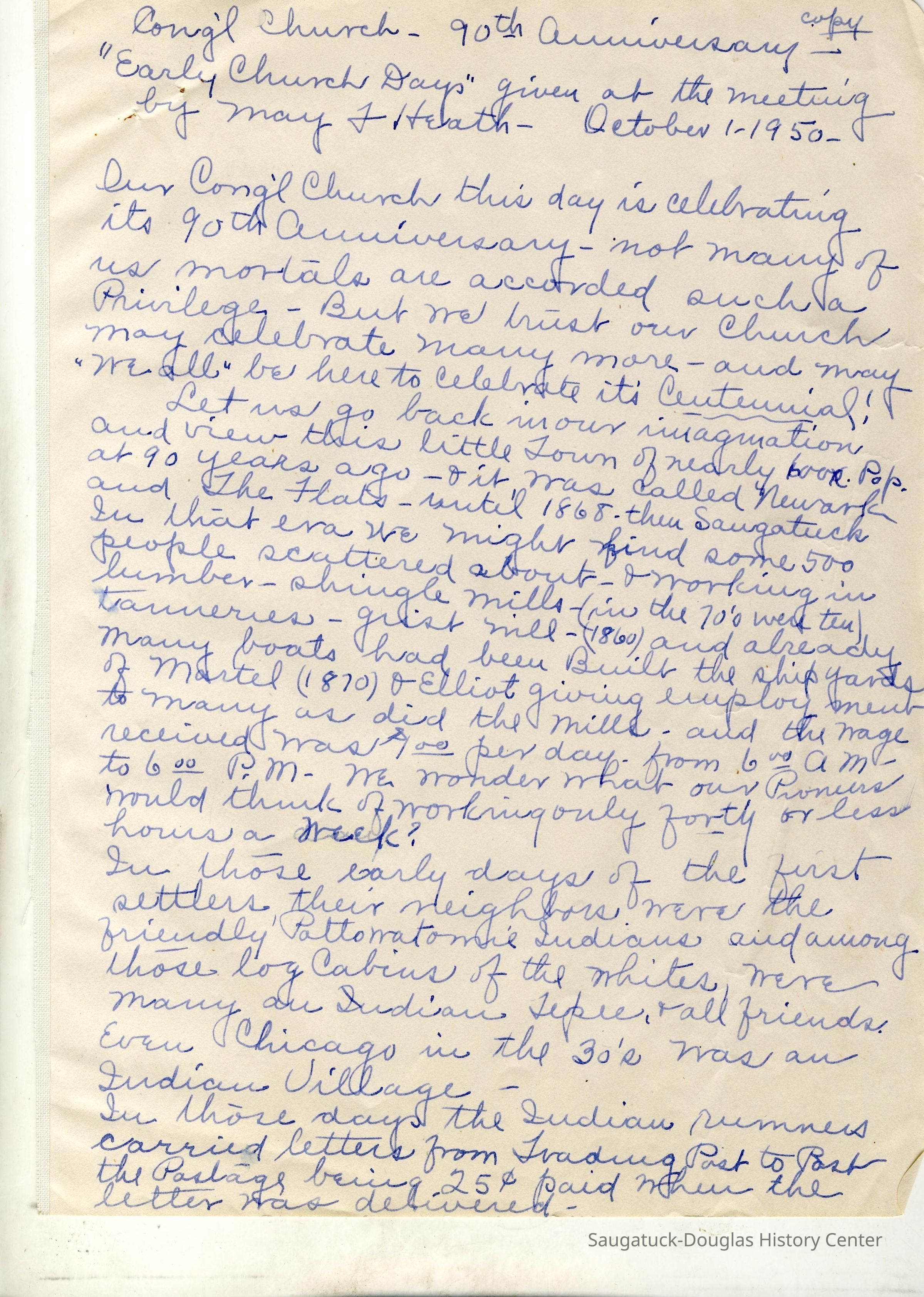
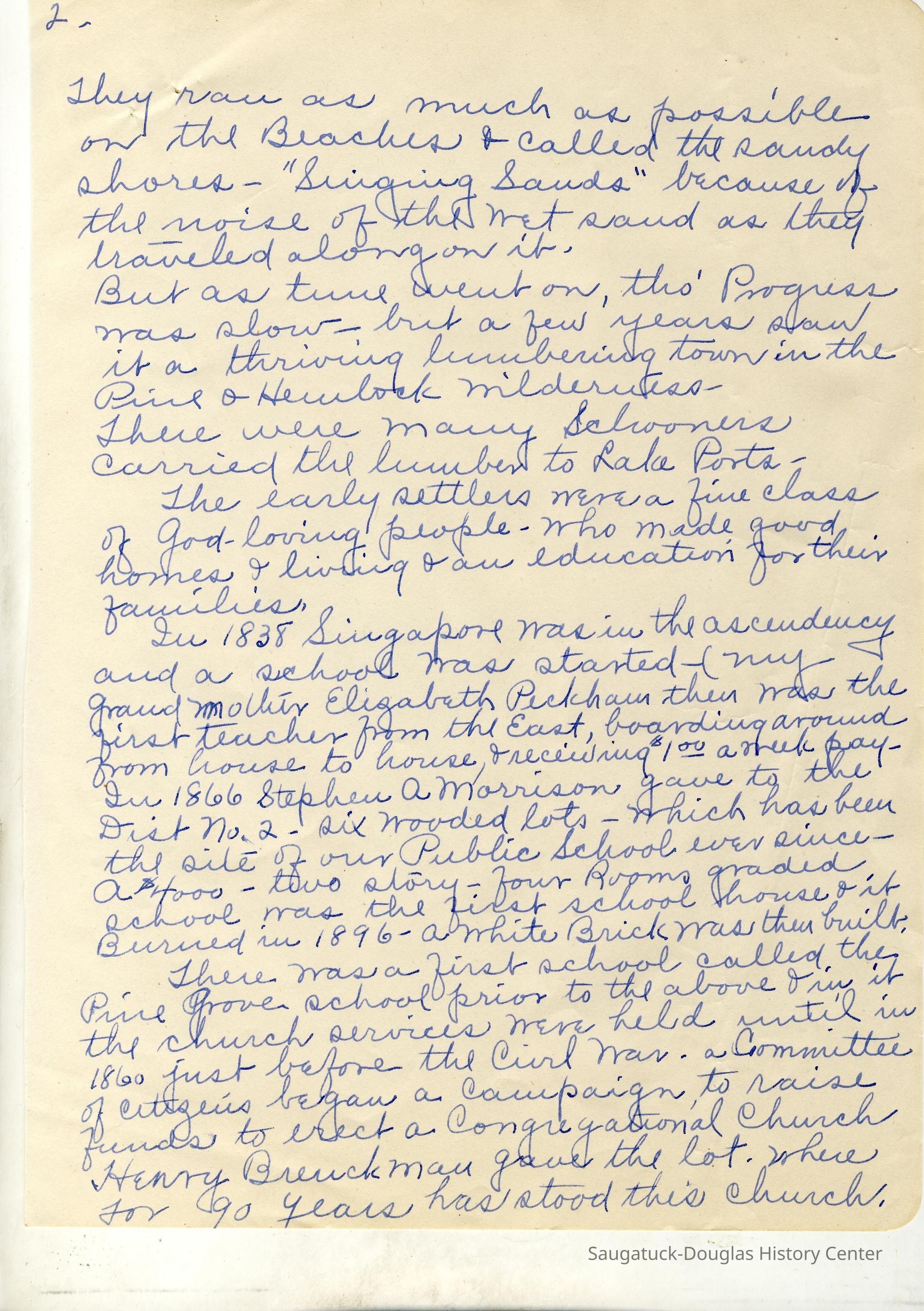
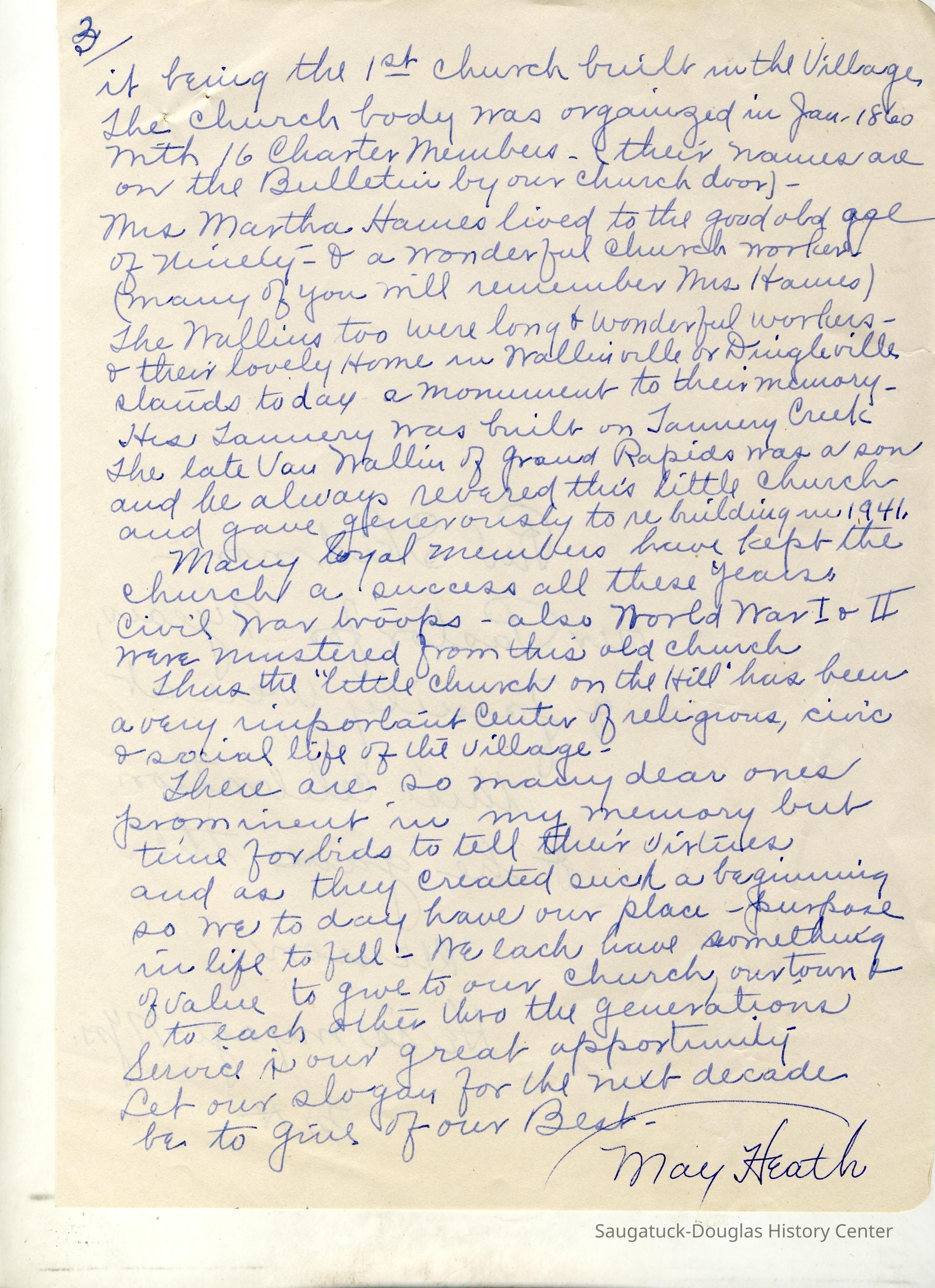
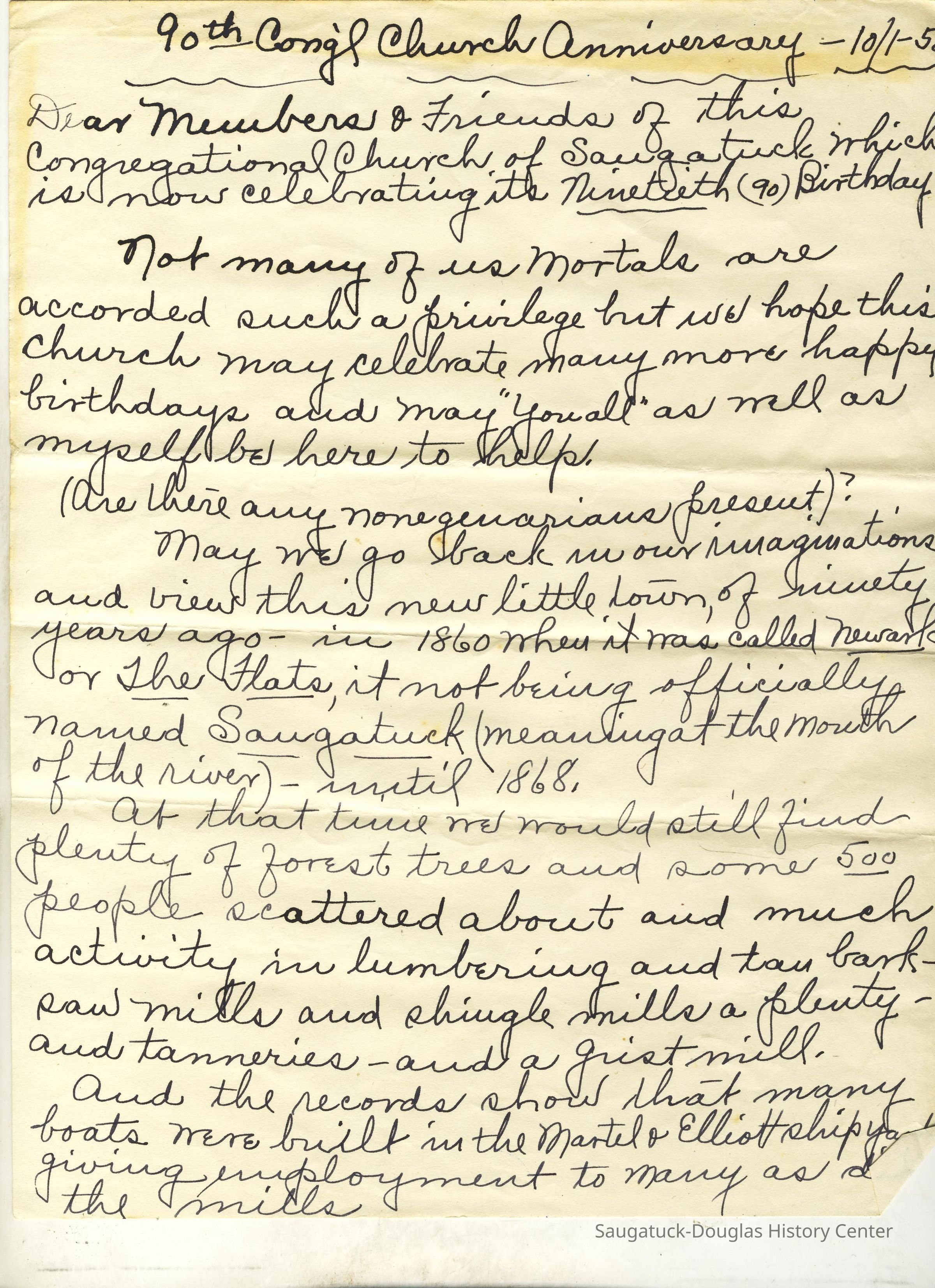
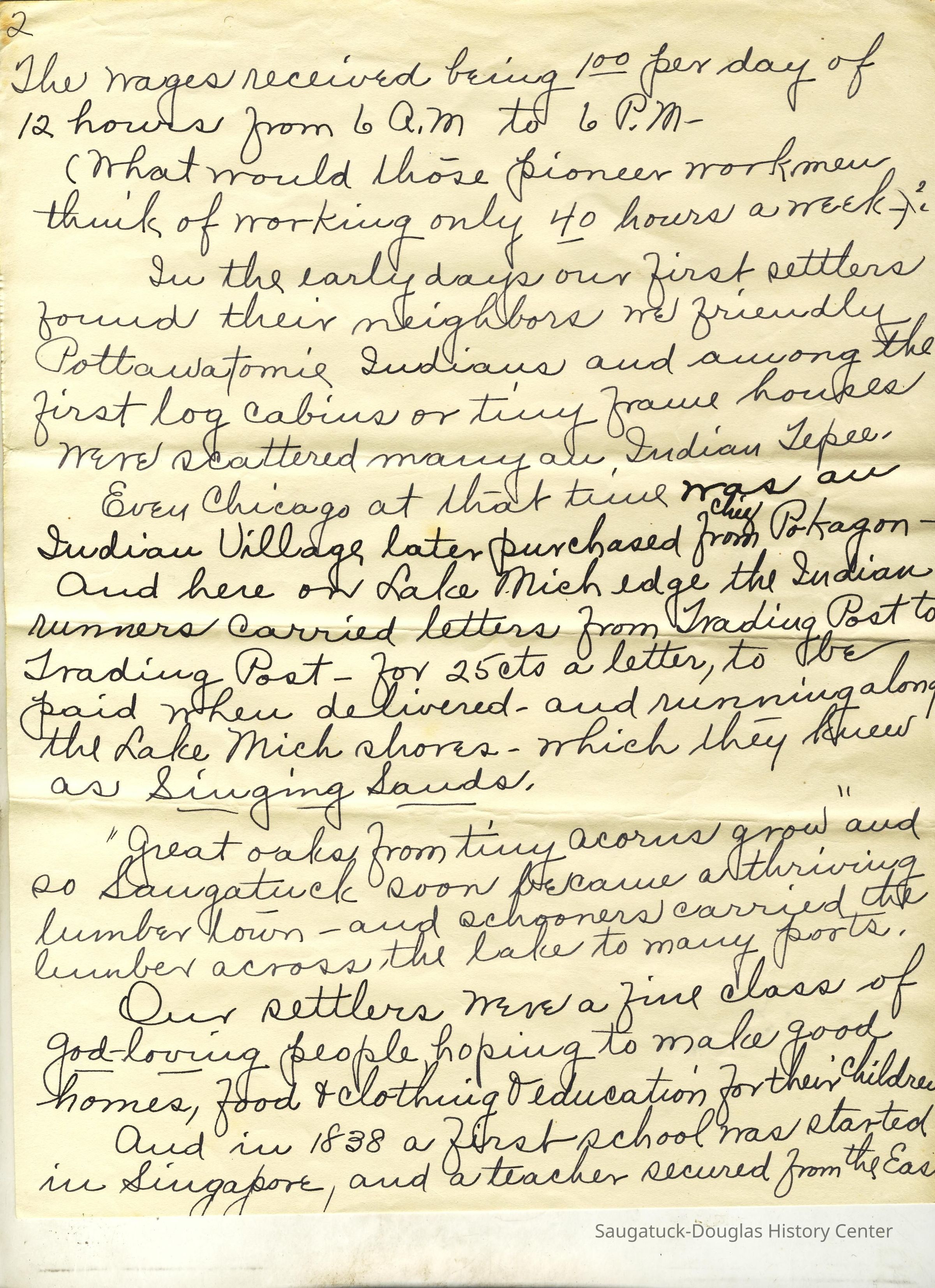
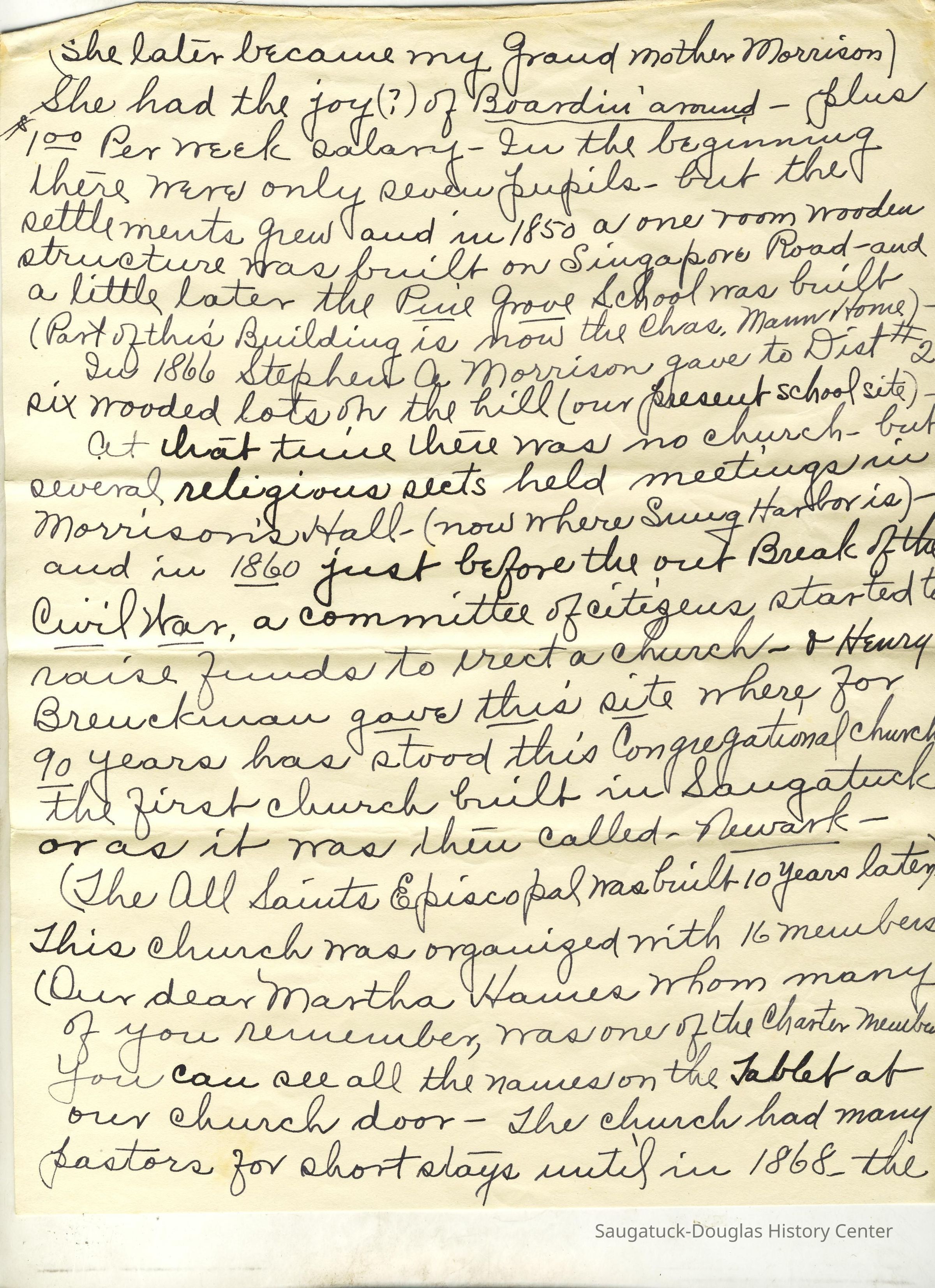
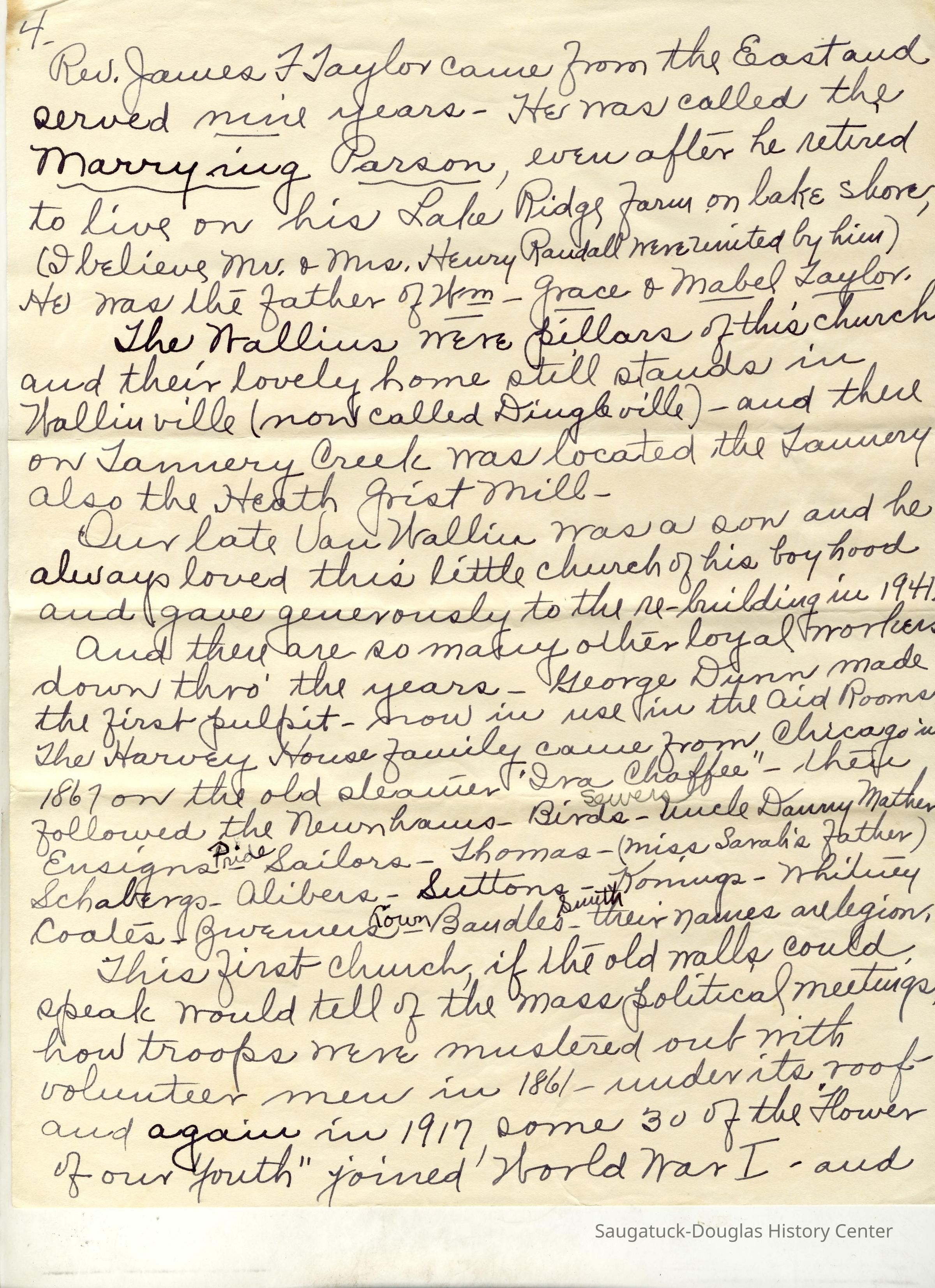
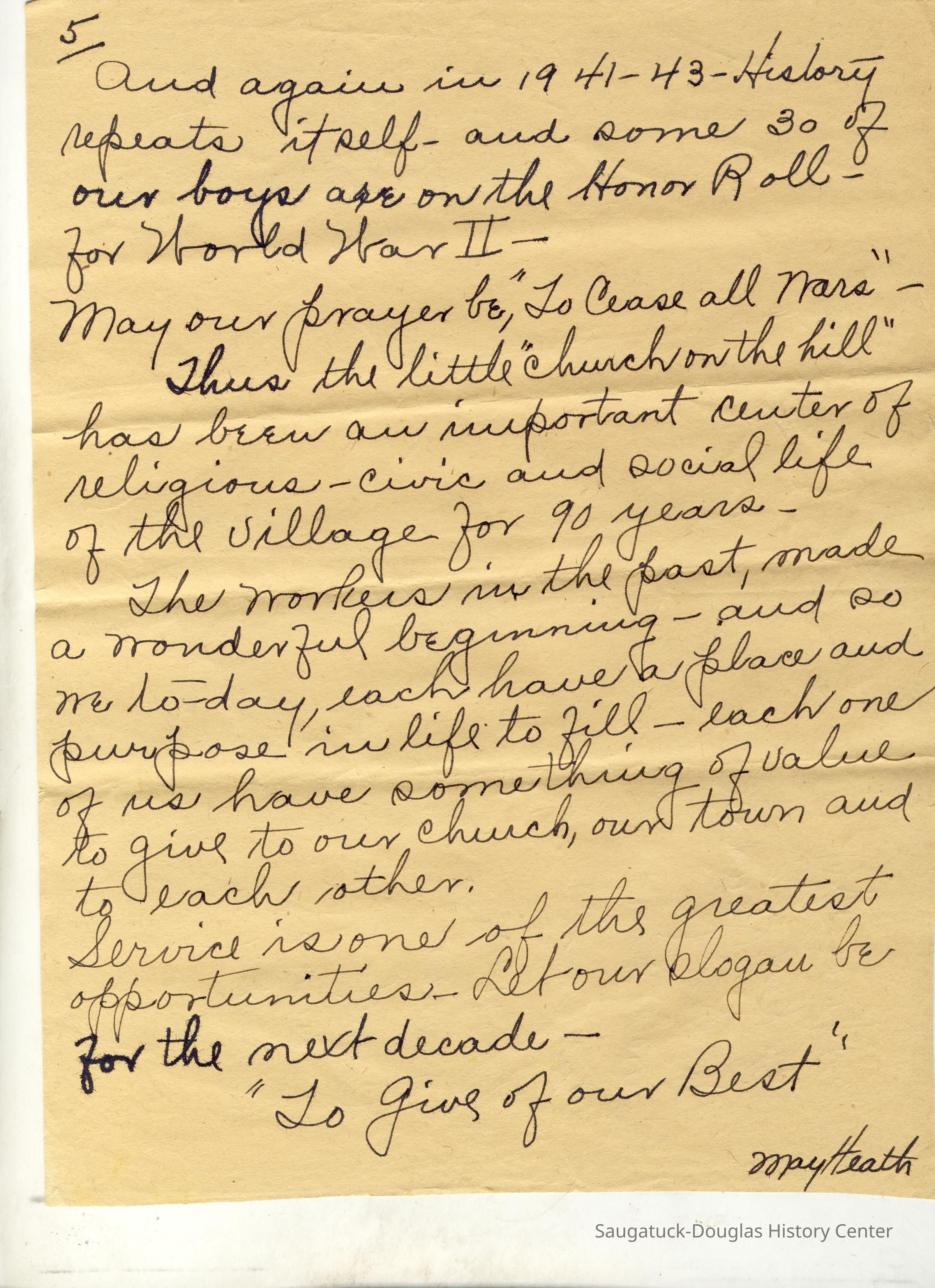
NINETIETH ANNIVERSARY "Early Church Days" Mrs. D. A. Heath October 1, 1950 Dear Members arid Friends of this congregational Church, which today is celebrating its ninetieth birthday. Not many of us mortals are accorded such a privilege but we trust this church may celebrate many, many more and may "you all" as well as myself be here to help. (Are any nonagenarians present?) Let us go back in our vivid imaginations and view this little town, of 90 years ago in 1860, when it as called Newark, or the Flats, for it did not receive the name "Saugatuck" until 1868. In that era we would find some 500 people scattered about, and a great deal in lumber, saw and shingle mills (of which there were 10), tanneries, grist mills and already (the records show us) many boats were built and Martel and Elliott yards gave employment to many, as did the mills, and the wages received was one dollar a day from 6:00 A.M. to 6 P.M. What would our pioneers think of working only 40 hours a week. In the days of our first settlers, their neighbors were friendly Pottowatomie Indians and among the low cabins of the whites were many an Indian Tepee and all were friends. Even Chicago in those early days was an Indian Village. Here on Lake Michigan here the Indians runners carried the letters from trading post to trading post, they called the sandy shores ''Singing Sands" because of the noise as they traveled upon the wet sands. "But great oaks from tiny acorns grow" and so Saugatuck in a few short years became a thriving lumbering town in the wilderness. The early settlers too, were a fine class of God loving people, who hoped only to make good homes and a living and education for their families. In 1838 a school was started in Singapore, also a thriving saw mill town and a teacher secured from the East (my grand mother Morrison she became) had the "joy of boarding around" plus $1.00 a week salary and at the start had 7 pupils. In 1850 a one room school house was built on Singapore Road and a little later the Pine Grove School (a part of which is now the Charles Mann home). In 1866 Stephen A. Morrison gave to Dist. No. 2, six wooded lots, the site of our school today. A $4,000.000 2 story frame building was built. That was the first graded school. It was a happy little village and church meetings were held in the Pine Grove school and many lamented there was no Church Building, the many religious sects held meetings in Morrison's hall. In 1860 just before the Civil war broke out, a committee of citizens started out to raise funds to erect a church and Henry Breuckman gave the site, where fpr 90 years has stood this Congregational Church, it being the first church built in Saugatuck, or as it was known "Newark". The church body was organized in January 1860 with 16 charter members. Mrs. George Hames was one of the charter members, and a faithful; one to the last (many of you will remember Mrs. Hames). The Wallins were also charter members. There were many pastors, who came for short stays, until James F. Taylor came in 1868 and served until 1877. He was called the Marrying Parson (I think Mr. and Mrs. Henry Randall were united by him at his Lake Ridge farm on the lakeshore to which he retired. He was the father of our friends Wm. A., Grace and Mabel Taylor. The Wallins were pillars of this church and their lovely home still stands in Dingleville, though in those days it was called Wallinville as there on tannery creek was located Wallin Tannery. The Late Van Wallin was a son and he always loved this little church and gave generously to the church's rebuilding in 1941. Houses, Dunns, Suttons, Koning, Schaberg and there are many others I could love to tell you about, but time forbids. But the little wooden one room structure (the first church) was built in 1860 and in it were held school and town meetings, social gatherings, mass political meetings. In 1861 was held Saugatuck's first "Civil War Meeting" upon the out break of that war. Here troops were mustered with volunteer men, young and old. Again in 1917 some 30 of the flower of our youth registered and joined the First World War. History repeats itself when in l941-1943 30 more of our church boys are on the Honor Roll for World far II. Lay it please God to cease all wars! Thus "The little church on the hill" has been an important Center of religious, civic and social life of the village. It has never been closed though at times we had no regular pastor. George Dunn made the first pulpit in 1860, which was in use for 80 years and now still honored in the church parlors and upon it rests an old Bible from the Ship "H. D. Moore" which Capt. C. B. Coates presented. The H. L. House family came from Chicago in 1867 on the old steamer "Ira Chaffee" and there were the Ensigns, Sailors, Geer, Uncle Danny Mather, Alibers, Houtkamps, Olsons, Bird, Newnham, Zwemers, Bandles and hundreds more, all loyal workers of the past and as they created such a beginning, so we today each have our place and purpose in life to fill. We each have something of value to give to our church, our town and to each other. Service is one of our greatest opportunities. Let our slogan for the next decade be "To Give Of Our Best."
Churches and religion
Winthers, Sally
2023.10
Found in Collection
Heath, May (Francis) 1873-1961
1950
Digital data in CatalogIt
First Congregational Church SaugatuckBreuckman, Henry 1824-1888Hames, George W. 1834-1917Taylor, James Franklin 1824-1903Wallin, Van Arthur 1866-1942Dunn, George E. 1835-1903
This information was copied from the pre-2023 SDHC website. The location of an original version was unknown at the time of cataloging.
05/26/2026
05/26/2026